Life Made Visible
The ankh is the ancient Egyptian hieroglyph for “life” or “to live.” In temple and funerary art, a deity may hold it in the hand or extend it toward the nose of a king, expressing the divine gift and renewal of life. It also appeared as an amulet, joining earthly vitality to hopes for continued existence after death.
What Is Known — and What Is Not
Its looped form has inspired many theories. A sandal strap, a tied bow, and combinations of male and female signs have all been proposed, but no single explanation is certain. “Key of life” is a useful modern name, not a literal translation of the Egyptian word.
Later Esoteric Life
The sign survived in transformed settings, including the looped cross used by some Egyptian Christians, and was later adopted by occult, Kemetic, and popular spiritual movements. In a contemporary practice it can stand for vitality, continuity, or reverence for life, provided those meanings are presented as modern interpretation rather than a secret doctrine shared by all Egyptians.
The Circle That Consumes Itself
The ouroboros is a serpent, or sometimes a dragon, closing a circle by biting its own tail. Serpentine circles occur in ancient Egyptian funerary and cosmological imagery, where they can mark a protected, self-contained realm. The Greek name means “tail-devourer,” and the image became prominent in the Greco-Egyptian world.
Alchemy and Recurrence
Alchemical manuscripts made the creature an emblem of matter that transforms through its own processes: dissolution feeding formation, end returning as beginning. It can suggest recurrence, unity, containment, self-renewal, or the dangerous exhaustion of a system trapped within itself. The surrounding text determines which sense is active.
A Modern Mirror
Depth psychology and modern occultism often read the ouroboros as an image of psychic totality or undifferentiated beginnings. Those are influential later readings, not the only meaning of the ancient sign. As a contemplative emblem, its strongest question is not merely “What repeats?” but “Does this cycle renew, imprison, or transform?”
The Restored Eye
The Eye of Horus is also called the wedjat, the “sound” or “restored” eye. In Egyptian myth, the eye of Horus is injured or taken during his conflict with Seth and subsequently made whole. That recovery gave the sign its associations with protection, healing, completeness, and the restoration of rightful order.
Its stylized anatomy combines a human eye with markings associated with the falcon, the bird of Horus. Wedjat amulets were worn by the living and placed with the dead; painted or carved eyes could also protect a body, object, or sacred space.
Horus Is Not Ra
The Eye of Horus and the Eye of Ra overlap in Egyptian religious imagery, but they are not simply interchangeable. The former is especially tied to injury and restoration; the latter can personify the sun god's active, royal, and at times destructive power. Modern claims that every line encodes a chakra, brain structure, or fixed mathematical fraction should not be mistaken for the historical core.
A Map of Emanation
The familiar Kabbalistic Tree of Life arranges ten sefirot: modes through which the infinite divine is revealed, related, and contemplated. The diagram belongs to the history of Jewish mysticism, especially medieval Kabbalah and its later developments. It is not a prehistoric universal chart that appeared unchanged in every religion.
Reading the Sefirot
The sefirot form a dynamic order of giving and receiving, expansion and restraint, wisdom and understanding, beauty, foundation, and embodied presence. Different Kabbalistic schools explain their relations in different ways; the Tree is therefore better approached as a theological and contemplative grammar than as a simple ladder of personal achievement.
Kabbalah and Qabalah
Christian Cabala and, later, Hermetic Qabalah adapted the diagram to Christian theology, astrology, tarot, alchemy, and ceremonial magic. Those correspondences are historically important but later than Jewish Kabbalah. A responsible esoteric reading names which stream it is using instead of merging them into a single timeless system.
Difference in Motion
Yin and yang are relational qualities in Chinese thought. Yin may describe the shaded, receptive, inward, cool, or yielding aspect of a situation; yang the bright, active, outward, warm, or assertive aspect. Neither is inherently good or evil, and neither exists alone. What is yin in one relation may be yang in another.
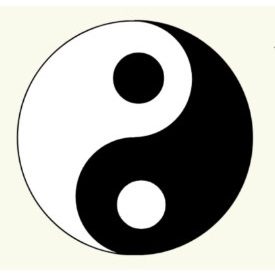
The familiar black-and-white taijitu shows this mutual dependence through a flowing division and a seed of each side within the other. Its lesson is dynamic change: fullness turns, extremes reverse, and apparent opposites participate in one process.
Beyond Decorative “Balance”
Yin-yang theory informs Chinese cosmology, medicine, divination, and Daoist thought, but these traditions do not reduce it to a slogan about perfect symmetry or fixed male and female roles. Western occultists may use the image comparatively, yet such use is an adaptation. The symbol is most precise when it asks how forces condition and transform one another in a particular context.
One Shape, Several Histories
A hexagram is the geometry of two interlaced triangles. Variants occur in many cultures, so the shape alone should not automatically be called the Seal of Solomon. In Jewish art it eventually became strongly associated with the Magen David, or Star of David, while its status as a widespread Jewish communal emblem developed comparatively late.
The Legendary Seal
Medieval Jewish, Islamic, and magical traditions imagined Solomon's seal as a divinely authorized sign by which the wise king commanded spirits and exercised judgment. The legendary seal was not always drawn as a hexagram; pentagrams and other devices also appear. Magical texts later placed the hexagram on talismans, seals, and ritual diagrams.
Esoteric Geometry
Western occult systems often interpret the interlaced triangles as fire and water, above and below, or the union of complementary powers. That symbolism is useful within those systems, but it is a later correspondence rather than the sole ancient meaning. Context — religious, communal, decorative, or magical — decides what the emblem is doing.
A Figure on Magical Gems
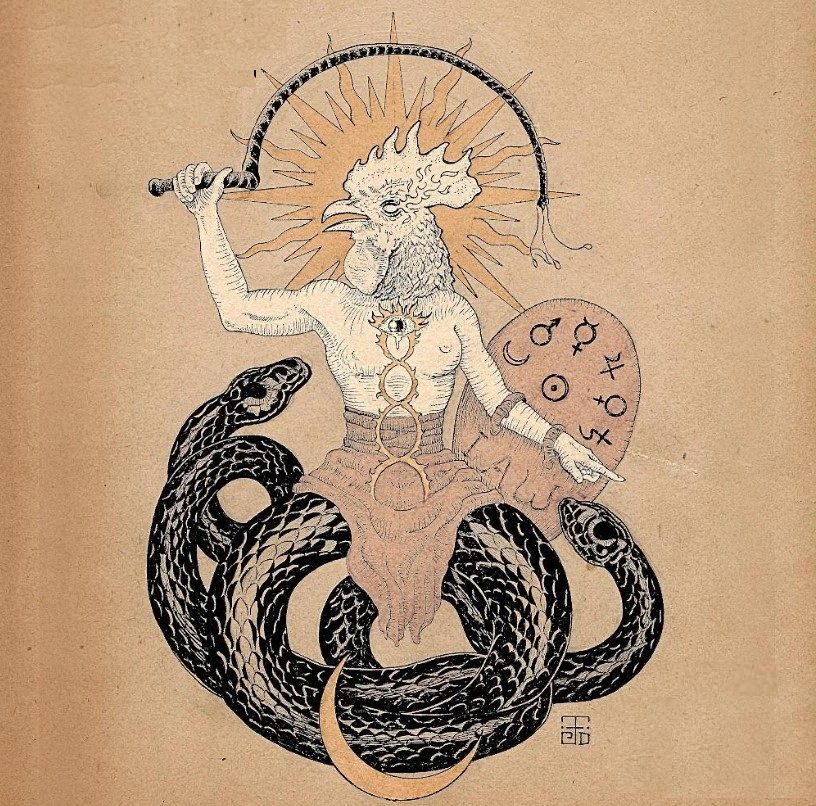
Abrasax — often rendered Abraxas in modern writing — appears in inscriptions on engraved gems of the late Roman world. A frequent image combines a rooster's head, a human torso, serpent legs, a whip, and a shield. These objects belong to the diverse ritual and magical environment of Late Antiquity, where Greek, Egyptian, Jewish, and other names and images could meet on one stone.
The Problem with Easy Labels
Ancient heresiologists connected the name with the teacher Basilides, and the Greek letter values of ABRASAX total 365. Yet not every gem bearing the name is securely “Gnostic,” nor do the surviving objects express one uniform theology. “Magical gem” is often the more careful historical description.
Modern Reinvention
Modern occultists and writers, notably in Jungian circles, turned Abrasax into an image that exceeds ordinary moral oppositions. That compelling interpretation belongs to the modern afterlife of the figure. Historically, Abrasax is best encountered as a deliberately composite power whose exact function depended on inscription, image, wearer, and rite.
The Herald's Staff
The caduceus is the staff of Hermes, called Mercury by the Romans. Usually shown with two entwined serpents and sometimes wings, it belongs to a god of messages, travel, boundaries, exchange, eloquence, and commerce. As a herald's emblem, it can also evoke negotiation and safe passage between opposed territories.
Not the Medical Rod
The caduceus is frequently used as a medical logo today, especially in the United States, but the classical emblem of healing is the Rod of Asclepius: one serpent around an unworn staff. Confusing the two erases their different mythic functions.
Hermetic and Alchemical Use
Because Hermes became linked with the Hermetic tradition and alchemical Mercury, later esoteric readers saw the paired serpents as volatile forces brought into relation, with the staff as an ordering axis. This is a legitimate later reception, not evidence that the Greek emblem originally encoded every modern energy system. Its most durable theme is mediation: movement between worlds, meanings, and states.
Five Lines, Many Traditions
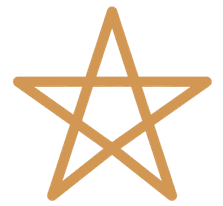
The pentagram is a five-pointed star drawn by five continuous strokes. Its geometry was known in antiquity; Pythagorean communities associated it with recognition and well-being. Christian use could connect its five points with the wounds of Christ, while later European magical texts placed it in protective seals and ritual figures.
The Elemental Star
Modern Western esotericism commonly assigns the four lower points to earth, air, fire, and water and the upper point to spirit. A pentagram enclosed by a circle is often called a pentacle today, although the historical word pentacle could refer more broadly to a magical diagram or talisman.
Orientation and Context
An inverted pentagram is not universally or timelessly “evil.” Its meanings depend on the period and community; specifically Satanic readings are modern. In ceremonial magic, Wicca, modern Paganism, and other currents, the star may signify protection, embodiment, consecrated space, or the relation between spirit and matter. The surrounding practice matters more than orientation alone.
The Protective Hand
The hamsa is a hand-shaped amulet found across North Africa and the Middle East. Its name relates to the word for five. The hand may be open and symmetrical or more naturalistic, and an eye is often placed in the palm. It is especially associated with protection from the evil eye, harmful envy, and misfortune.
Shared, Not Singular
Jewish communities may call it the Hand of Miriam or hamesh; Muslim traditions often know it as the Hand of Fatima. Its deeper origin is debated, and no single modern community exhausts its history. The hamsa is a strong example of an amulet that crossed languages, regions, and religious boundaries while acquiring local meanings.
How to Read It
Contemporary wearers use the hand for blessing, welcome, protection, or identity. The eye in the palm does not make it an Egyptian Eye of Horus, and the hamsa has no historical connection to Daoist yin-yang philosophy. Its power as a symbol lies precisely in its long regional life and its ability to carry related meanings without becoming culturally identical everywhere.
A Sacred Syllable
Om, or Aum, is first a sound and only secondarily a written sign. It holds a foundational place in Hindu traditions and is discussed extensively in the Upanishads. It may open and close recitation, prayer, meditation, or ritual, gathering attention into a syllable treated as a sonic form of ultimate reality.
A-U-M and the Fourth
The Mandukya Upanishad famously relates A, U, and M to waking, dreaming, and deep sleep, while the silence or “fourth” points beyond those changing states. Other Hindu schools interpret the syllable through their own theology. Buddhist and Jain traditions also use Om, often within distinct mantras and doctrinal settings.
Sound Before Slogan
The graphic form is not a generic icon for every Asian spirituality, and claims that Om has one scientifically privileged frequency are modern inventions. Its pronunciation and ritual role vary. A respectful encounter begins with the living tradition and the specific mantra, not with a claim that the glyph automatically activates a universal mechanism.
More Than a Circular Pattern
Mandala is a Sanskrit word often translated as “circle,” but in Hindu and Buddhist traditions it can designate a consecrated diagram, a ritual field, a palace of a deity, or an ordered cosmos. Geometry, direction, color, figure, and threshold work together; decoration is inseparable from function.
A Place to Enter
In tantric Buddhist practice, a mandala may map an enlightened realm and support initiation, visualization, offering, and meditation. The practitioner does not merely observe a picture but imaginatively enters an ordered sacred world. Sand mandalas make impermanence visible when an intricate construction is ritually dismantled.
Modern Psychological Reception
Carl Jung used spontaneous circular images as signs of psychic ordering and wholeness, shaping the modern therapeutic meaning of “mandala.” That use should be distinguished from Asian ritual lineages. Coloring a radial pattern can be contemplative, but it does not reproduce the meaning of a traditionally transmitted mandala without its texts, deities, and ritual context.
A Modern Esoteric Diagram
The enneagram is a nine-point figure formed by a circle, a triangle, and a six-point sequence. It became publicly known through G. I. Gurdjieff in the early twentieth century, who taught it as a diagram of process and transformation. He did not present the familiar nine personality types used today.
From Process to Personality
Oscar Ichazo later connected a ninefold scheme with ego fixations, and Claudio Naranjo helped develop and transmit the personality-based system in the 1970s. Contemporary schools have expanded it into a language of types, wings, instincts, and lines. Claims that this exact typology descends unchanged from ancient Sufism or another single ancient source are not securely documented.
Use Without Confinement
The modern Enneagram can prompt useful questions about habitual attention, defense, and motivation, but it is not a clinically established diagnostic instrument. Its best use is provisional and reflective: a map for noticing patterns, not a verdict on identity. If the symbol becomes a label that explains everything, it has ceased to encourage the movement it was meant to describe.
Wisdom Personified
Sophia is the Greek word for wisdom. Long before and alongside texts called Gnostic, Jewish wisdom literature and early Christian writing could speak of Wisdom as a vivid, sometimes personified presence. In several mythic cosmologies of Late Antiquity, Sophia becomes a named divine figure within a drama of emanation, rupture, and restoration.
Many Myths, Not One Biography
Sethian, Valentinian, and related texts do not tell one identical story. In some, an act of Sophia contributes to the emergence of a deficient ruler or world; in others, higher and lower aspects of Wisdom play different roles. Her grief, repentance, illumination, and return can express how divine insight becomes entangled in limitation yet remains oriented toward fullness.
A Careful Esoteric Reading
Modern readers often treat Sophia as the sacred feminine, the soul's exiled wisdom, or a principle neglected by rigid systems. These are meaningful interpretations, but she should not be flattened into one universal goddess or a simple opposite of a male deity. Her complexity is the point: wisdom in these myths can be luminous, searching, vulnerable, and transformative at once.
The Ignorant Ruler
Yaldabaoth appears in several Sethian and related texts preserved among the Nag Hammadi writings. Often portrayed as a lion-faced serpent and called by names such as Sakla or Samael in some accounts, he is a chief ruler who mistakes limited power for absolute divinity. His central fault is ignorance joined to arrogance.
Cosmic Craftsman, Not Universal Doctrine
In the Apocryphon of John, Yaldabaoth arises within a complex myth involving Sophia and produces rulers and the lower cosmos. The human being nevertheless contains a light that exceeds his order. Different texts vary, and not every ancient group commonly labeled “Gnostic” used this figure. He should not be treated as a simple, universally accepted equation with the God of the Hebrew Bible.
The Modern Psychological Figure
Contemporary esoteric readers often see Yaldabaoth as false totality: the voice, institution, or ego that declares its partial world to be the whole. That is a modern symbolic application, not a substitute for the ancient myth. Read this way, the figure warns against power that cannot recognize the source, limits, or life beyond itself.
The Fullness
Pleroma is Greek for fullness or completion. The word has a broader life in early Christian writing, but in Valentinian and other Gnostic cosmologies it becomes a technical term for divine fullness: the ordered reality of emanated powers often called aeons.
Beyond a Physical Heaven
The Pleroma is not simply a location above the sky. It describes a mode of undiminished divine relation, contrasted in many myths with deficiency, fragmentation, or ignorance. Valentinian accounts arrange and name the aeons differently, so there is no single diagram that settles every version of the system.
Wholeness as a Later Metaphor
Modern occult and psychological writing frequently uses Pleroma for undifferentiated totality, the source of opposites, or an interior state of integration. Those readings extend the ancient term. Used carefully, Pleroma can name the intuition that fragments belong to a greater order; used carelessly, it becomes a vague synonym for “energy.” Its historical force is fullness of being, not a measurable field.
Purity That Emerges
The lotus rises from muddy water while its blossom remains visually unstained, making it a powerful image of purity, emergence, beauty, and spiritual awakening. In South Asian sacred art, gods, Buddhas, and bodhisattvas may stand or sit upon a lotus throne, indicating a presence manifest in the world yet not bound by its confusion.
Traditions Give It Precision
Hindu texts and images connect the flower with creation, divine beauty, prosperity, and particular deities. Buddhist traditions use it for awakening, compassion, and the potential of beings to unfold wisdom amid difficult conditions. Color, posture, number of petals, and accompanying figure can alter the meaning; there is no single universal color code.
Inner Iconography
Yogic and tantric diagrams may depict subtle centers as lotuses with specified petals, syllables, and deities. Modern chakra charts simplify these intricate systems and often combine sources from different periods. As a personal emblem, the lotus can honor growth through difficulty, but its depth comes from the traditions that made the flower more than a decorative promise of positivity.
Threefold Motion
A triskelion is a three-armed or three-legged figure arranged around a center. The Greek name means “three-legged,” and a running-legged form became famously associated with Sicily. Triple spirals also appear in prehistoric monuments, including the Neolithic passage tomb at Newgrange in Ireland.
Similar Form Does Not Mean One Origin
Threefold motifs occur in different places and periods because rotation, repetition, and triadic structure are visually powerful. The Newgrange spiral predates the historical Celtic cultures by millennia, so calling every triple spiral an ancient “Celtic trinity” obscures chronology. The original meaning of many prehistoric examples remains unknown.
Modern Celtic Reception
Contemporary Celtic and Pagan movements often interpret the three arms as land, sea, and sky; birth, life, and death; or another chosen triad. Those are modern or reconstructed meanings unless a specific historical source supports them. What the design securely conveys across contexts is movement held around a center: three directions that remain part of one turning form.
From Seal to Personal Glyph
Sigil derives from the Latin sigillum, “seal.” Medieval and early modern magical books used seals, characters, and signatures connected with angels, spirits, planets, and ritual authorities. These inherited designs are not the same as the personal sigils commonly made today.
The Spare Method
In the early twentieth century, Austin Osman Spare developed an influential way to turn a written desire into a compact glyph, often by removing repeated letters and combining the remainder. Later chaos magic adopted and diversified this approach, adding ideas of charging, altered attention, and letting go of conscious fixation. No single procedure is mandatory or ancient.
Practice with Clarity
A sigil can function as a designed concentration point: intention compressed into a form that bypasses habitual phrasing. Its value need not depend on promises of automatic supernatural results. Clear wording, consent, proportion, and reflection matter. A responsible practitioner directs the work toward their own action and perception rather than using a symbol as imagined permission to control another person.
A Name Older Than the Drawing
The Old Norse name ægishjálmr means a “helm of awe” or terror. In the Eddic story of Fafnir, it describes a fear-inducing possession or power. That literary helm should not automatically be identified with the familiar radial magical stave now printed under the same name.
An Icelandic Magical Stave
The eight-armed design belongs to the history of Icelandic galdrastafir, magical staves recorded in manuscripts from the early modern period and later collections. Instructions could prescribe drawing or carrying such a sign for protection, dominance, or courage. It is therefore misleading to call the standard graphic a Viking-age rune: it is neither a letter of the runic alphabet nor securely attested as that design in the Viking Age.
Modern Use
Today the Ægishjálmur is widely used in Heathen, occult, and Nordic-inspired settings as an emblem of defense and steadfastness. That modern life is valid when its chronology is stated honestly. The symbol carries an Icelandic magical inheritance, while its name reaches back into older Norse story.
Thor's Consecrating Hammer
Mjölnir is the hammer of Thor, the Norse god who defends gods and humans against destructive powers. Mythic narratives emphasize its overwhelming force and its return to the wielder. The hammer is not only a weapon: Thor also uses it in acts of blessing, hallowing, and restoration, joining protection with sacred order.
The Archaeological Emblem
Hammer-shaped pendants are known from the Viking Age across parts of Scandinavia and beyond. They were worn as amulets and likely carried protective, devotional, or communal meaning, although an artifact's exact intention cannot always be recovered. In some settings, the hammer may also have marked attachment to traditional religion during growing contact with Christianity.
A Living Symbol
Modern Heathens wear Mjölnir as a sign of faith, protection, courage, kinship, and responsibility. Popular culture often reduces it to brute strength; the older material is richer. The hammer's esoteric value lies in power disciplined toward guardianship and consecration — the ability to defend a boundary and then make the space within it worthy of protection.

 Home
Home Knowledge
  Tools
Tools  Practice
  Divination
  Profile
 Contact