
 Home
Home Knowledge
  Tools
Tools  Practice
  Divination
  Profile
 Contact
The Chakras
How to Read This Page
Cakra (Sanskrit: चक्र) means “wheel” or “circle.” In Tantric and yogic traditions, cakras are subtle loci used in mantra, visualization, deity practice, and the ascent of Kuṇḍalinī—not anatomical organs that can be medically measured. Indian traditions preserve several chakra maps; there is no single universal count.
This page uses the influential six-centre sequence of Pūrṇānanda's 16th-century Ṣaṭ-Cakra-Nirūpaṇa, culminating in Sahasrāra, and places it beside the familiar modern seven-chakra system.
Important distinction: modern correspondences can be meaningful contemplative tools, but they should not be presented as ancient Sanskrit doctrine or medical fact. The seven-color diagram below uses the popular modern spectrum for navigation.
Select a chakra to compare its classical symbolism with its modern esoteric interpretation.
Kundalini: The Serpent Power
Kuṇḍalinī (Sanskrit: कुण्डलिनी) is Śakti in her latent, inward form. In the Ṣaṭ-Cakra-Nirūpaṇa she is imaged as a subtle power coiled three and a half times around the Svayaṃbhū-liṅga in Mūlādhāra. This is sacred subtle-body language, not a claim that a physical serpent or measurable substance lies inside the spine.
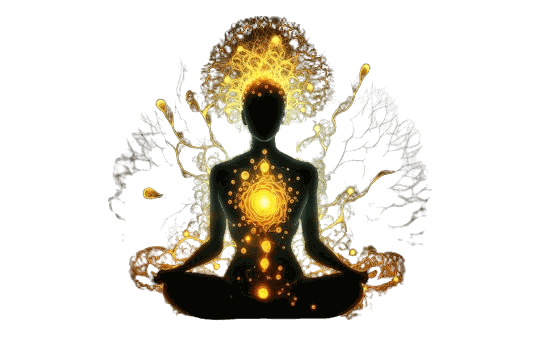
The Three Primary Nadis (Energy Channels)
Nāḍīs are subtle channels within yogic anatomy. They should not be equated literally with nerves, blood vessels, or brain hemispheres.
- Iḍā Nāḍī: The lunar, cooling current traditionally placed to the left.
- Piṅgalā Nāḍī: The solar, warming current traditionally placed to the right.
- Suṣumṇā Nāḍī: The central subtle channel through which Kuṇḍalinī is ritually visualized as ascending.
The Awakening Process
In this Tantric map, Kuṇḍalinī-Śakti is led through Suṣumṇā and the six bodily lotuses toward Sahasrāra, where Śakti and Śiva are contemplated in union. This symbolizes the reintegration of power and consciousness. Traditions differ in technique, theology, and interpretation; the process is not reducible to a universal promise of instant enlightenment.
Reported Experiences
Practitioners sometimes interpret unusual contemplative experiences through the language of Kuṇḍalinī. Reports may include:
- Physical Sensations: Intense heat, cold, or electricity-like currents running along the spine; involuntary body movements (kriyas); vibrations or tingling sensations.
- Sensory Experiences: Hearing inner sounds (like bells, flutes, or humming); seeing inner lights or symbols; heightened sensitivity to external stimuli.
- Emotional & Psychological Shifts: Bliss, grief, fear, vivid dreams, altered self-perception, mystical unity, or periods of unusual sensitivity.
An intense sensation is not proof of spiritual attainment. Similar experiences can arise through breathwork, stress, sleep disruption, trauma responses, medication, or medical and psychological conditions.
Preparation and Cautions
Traditional Kuṇḍalinī work is gradual and normally embedded in ethical discipline, stable daily practice, initiation or instruction, and the guidance of a competent teacher.
- Build a foundation: Favor sleep, ordinary routines, ethical conduct, gentle āsana, natural breathing, and short meditation before advanced methods.
- Do not force: Avoid prolonged breath retention, extreme hyperventilation, aggressive bandhas, fasting, sleep deprivation, or intoxicants as shortcuts.
- Choose guidance carefully: A trustworthy teacher respects consent, personal limits, medical care, and the student's ability to stop.
Stop and seek support if practice is followed by persistent insomnia, panic, disorientation, loss of daily functioning, mania-like energy, frightening voices or visions, self-harm thoughts, chest pain, fainting, or seizures. “Kundalini syndrome” is not a formal medical diagnosis. Spiritual interpretation and qualified medical or mental-health care can coexist.
Sources & Interpretive Frame
The classical layer follows Pūrṇānanda's Ṣaṭ-Cakra-Nirūpaṇa as transmitted in Arthur Avalon's The Serpent Power. It is one influential Tantric map—not a claim that every Hindu, Buddhist, or yogic lineage uses the same centers or correspondences.
- Ṣaṭ-Cakra-Nirūpaṇa — Sanskrit text, translation, and commentary
- Historical context for the modern Western rainbow system
- Meditation and mindfulness safety overview
This page presents religious, historical, and esoteric material for education and reflection. It does not diagnose energy, physical illness, or mental-health conditions and is not a substitute for qualified care.
Continue with Guided Reflection
The interactive chakra test can suggest symbolic themes for journaling and contemplation. It does not measure subtle energy, diagnose imbalance, or replace medical and psychological assessment.
Open the Reflection Tool